
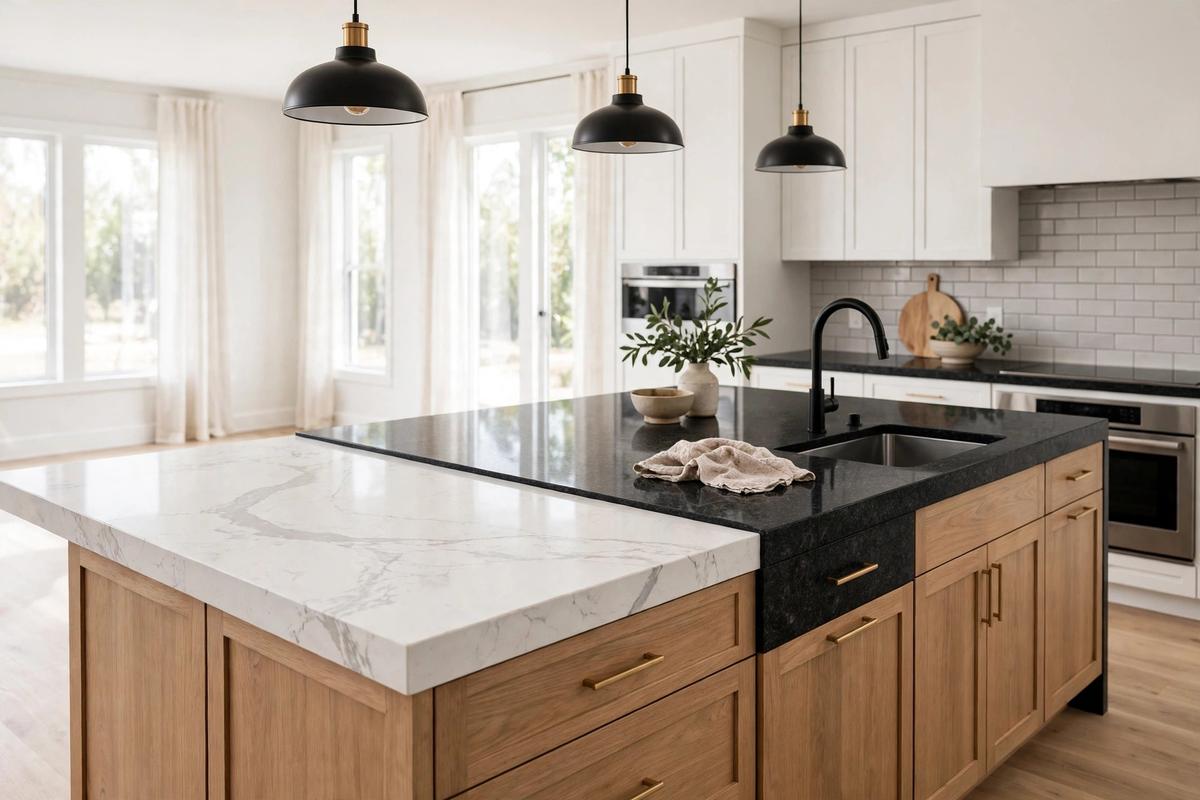
Quartz and granite are the two countertop materials multifamily developers ask about most — and the right choice depends less on looks than on how the kitchen will actually be used. Both work beautifully in rental units. They differ in maintenance, consistency, and what happens after the hundredth tenant moves in.
Quartz is an engineered stone: roughly 90% natural quartz crystal bound with resin. The result is a non-porous surface that never needs sealing, resists stains from coffee, wine and cooking oil, and cleans with soap and water. For property managers, that means no sealing schedule, no stain callouts at turnover, and a surface that looks the same in year five as it did at lease-up. Quartz is also consistent by design. The veining and color repeat from slab to slab, so a 200-unit project gets matching kitchens — and a replacement section cut years later still matches. Calacatta-look quartz gives the marble appearance residents love without marble's maintenance.
Granite is a natural stone, cut directly from the earth. Every slab is unique, with natural movement and depth that engineered surfaces imitate but never quite match. It handles heat well — a hot pan straight from the stove is less of a worry — and its hardness resists scratches from daily use. Granite needs sealing, typically once a year in a rental, and darker granites such as Black Galaxy hide wear better than lighter ones. For developers who want a natural-stone story in their leasing gallery, granite delivers it at a lower material cost than marble.
Both materials survive multifamily life well when specified correctly. Quartz resists stains and never needs sealing, which makes it the lower-maintenance choice for high-turnover buildings. Granite resists heat better and hides small chips in its natural pattern, which suits units where residents cook heavily. The practical difference is the maintenance calendar: quartz asks nothing after installation; granite asks for a sealer coat at each turnover or annually. For a property manager running hundreds of units, that one difference often decides the material.
Quartz wins on consistency. When a project needs 200 kitchens to look identical in photos and on tours, quartz delivers the same pattern every time. Granite wins on character — no two kitchens look exactly alike, which suits boutique buildings and premium units where uniqueness is a selling point. A common split: quartz for the standard and upgrade tiers, granite for premium units and leasing-gallery kitchens where the natural stone makes the strongest impression.
Both materials are produced to project scale. Quartz countertops typically ship in 15–20 days from order confirmation, cut and edge-finished to the project's templates, with sink cut-outs completed at the factory. Granite follows the same timeline, with slabs selected and matched by unit type before cutting. Ordering both from one supplier simplifies the decision: the same edge profiles, the same thickness options (2cm and 3cm), and one crating system marked by unit type. A multifamily cabinet package that pairs quartz in most units with granite in premium units stays simple to specify and simple to install.
Choose quartz when the priority is low maintenance, identical units across a large project, and no sealing schedule. Choose granite when the priority is natural-stone character, heat resistance, and a lower material cost for premium looks. Many U.S. multifamily projects use both — quartz for the bulk of the units, granite where the leasing team wants a natural-stone statement. Either way, the countertop should be specified together with the cabinets and flooring. A one-stop package — Thailand cabinets, quartz or granite countertops, and SPC flooring from a single supplier — keeps the finishes coordinated and the delivery schedule in one place.
Q: Does quartz really never need sealing? A: Correct. Quartz is non-porous, so it never needs sealing and cleans with soap and water. That is the main maintenance advantage over granite in rental units.
Q: How often does granite need to be sealed in a rental? A: Typically once a year, or at each unit turnover. Dark granites such as Black Galaxy show wear less and can stretch the interval.
Q: Will quartz match across 200 units? A: Yes — quartz veining is consistent by design, and cutting consecutive units from the same batch keeps the pattern uniform across the whole project.
Q: Can we mix quartz and granite in one project? A: Yes. A common split is quartz for standard and upgrade units and granite for premium units and the leasing gallery. Both are cut to the same templates and edge profiles.
Q: Who supplies both materials for multifamily projects? A: Dawson Stone and Cabinet produces quartz and granite countertops in our Thailand stone facility in Nong Yai, Chon Buri, alongside kitchen cabinets from our Thailand cabinets plant and our Malaysia cabinet factory in Muar, Johor — one supplier for the full multifamily cabinet and countertop package.
Contact Dawson Stone and Cabinet — one-stop cabinets, countertops and flooring for U.S. multifamily projects. Email: info@thailandcabinetry.com · Phone: +1-657-615-8019 · WhatsApp: +86 130 5543 1394.

Professional design team, with more tham 7 years experiences averagely in home’s design to meet the needs of different customers


 IPv6 network supported
 en
 es