
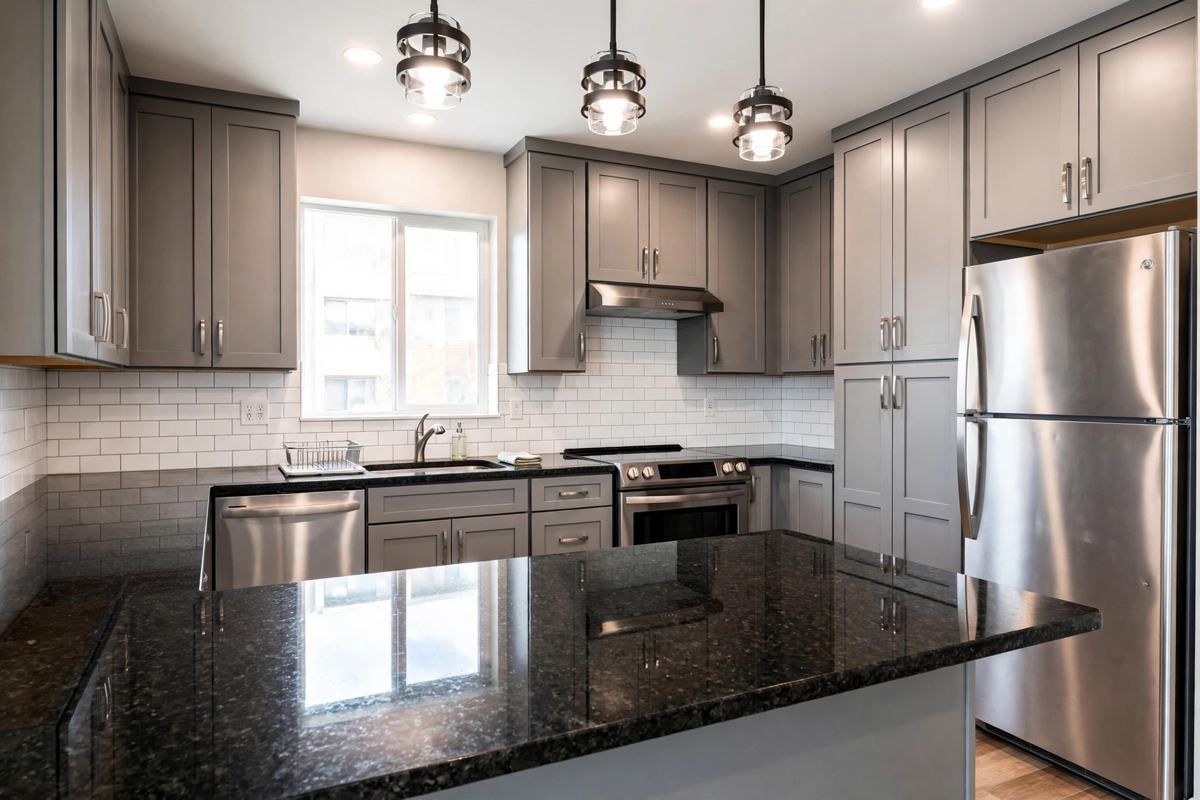
 Natural stone still earns its place in U.S. multifamily kitchens. Granite countertops give a project a premium, natural look that photographs well for leasing, while standing up to years of tenant use. This guide covers where granite makes sense, what to specify, and how factory-direct supply from Thailand cabinets production keeps a granite package consistent across hundreds of units.
Every granite slab is unique, which gives kitchens and clubhouse spaces a natural variation that engineered materials imitate but never fully match. For developers, granite offers three practical advantages: it is one of the hardest countertop materials in daily use, it tolerates hot pans better than most surfaces, and popular colors hold their appearance for decades, which protects the finish schedule through several tenant cycles.
Granite is porous, so it needs sealing — typically at installation and periodically after. Dark, dense colors hide wear best in rental kitchens, while very light colors show more and demand more care. Because slabs vary, a multifamily cabinet project should approve the actual color range from slab photos before production, not from a small sample alone. Weight also matters: granite tops need a level, well-supported cabinet run, which is why ordering countertops together with the cabinet package — one specification, one supplier — avoids fit problems on site.
For multifamily work, the repeat performers are mid-tone greys, black galaxy, steel grey, and warm beige granites. They pair cleanly with white shaker, grey, and wood-grain cabinet finishes, and they read as an upgrade in leasing photos without pushing the finish budget into luxury territory. Dawson supplies granite alongside quartz and marble from its Thailand stone facility, matched to Thailand cabinets and to output from its Malaysia cabinet factory, so a project can mix materials by building or unit type under one order.
State the thickness (2cm or 3cm), edge profile, sink cut-out type, and backsplash height in the purchase specification. Confirm whether tops ship polished and pre-sealed, how pieces are crated and labeled by unit, and what percentage of spare material is included for site damage. These details decide whether granite installs as fast as quartz on a multifamily schedule.
Q: Does granite need sealing in rental units?
A: Yes. A quality sealer at installation protects against staining, and property teams should plan periodic resealing. Dense dark granites are the most forgiving choice for rentals.
Q: Can granite and quartz be mixed in one project?
A: Yes — many developers use granite in premium units or amenity spaces and quartz in standard units. We produce both in the same facility and ship them under one specification.
Q: How does granite ship for a U.S. project?
A: Tops are cut to size, polished, sealed, and crated by unit type at our Thailand facility, then shipped from Laem Chabang port with the cabinet package.
Planning a granite package for your next project? Contact Dawson Stone and Cabinet: info@thailandcabinetry.com · +1-657-615-8019 · WhatsApp +86 130 5543 1394.

Professional design team, with more tham 7 years experiences averagely in home’s design to meet the needs of different customers


 IPv6 network supported
 en
 es